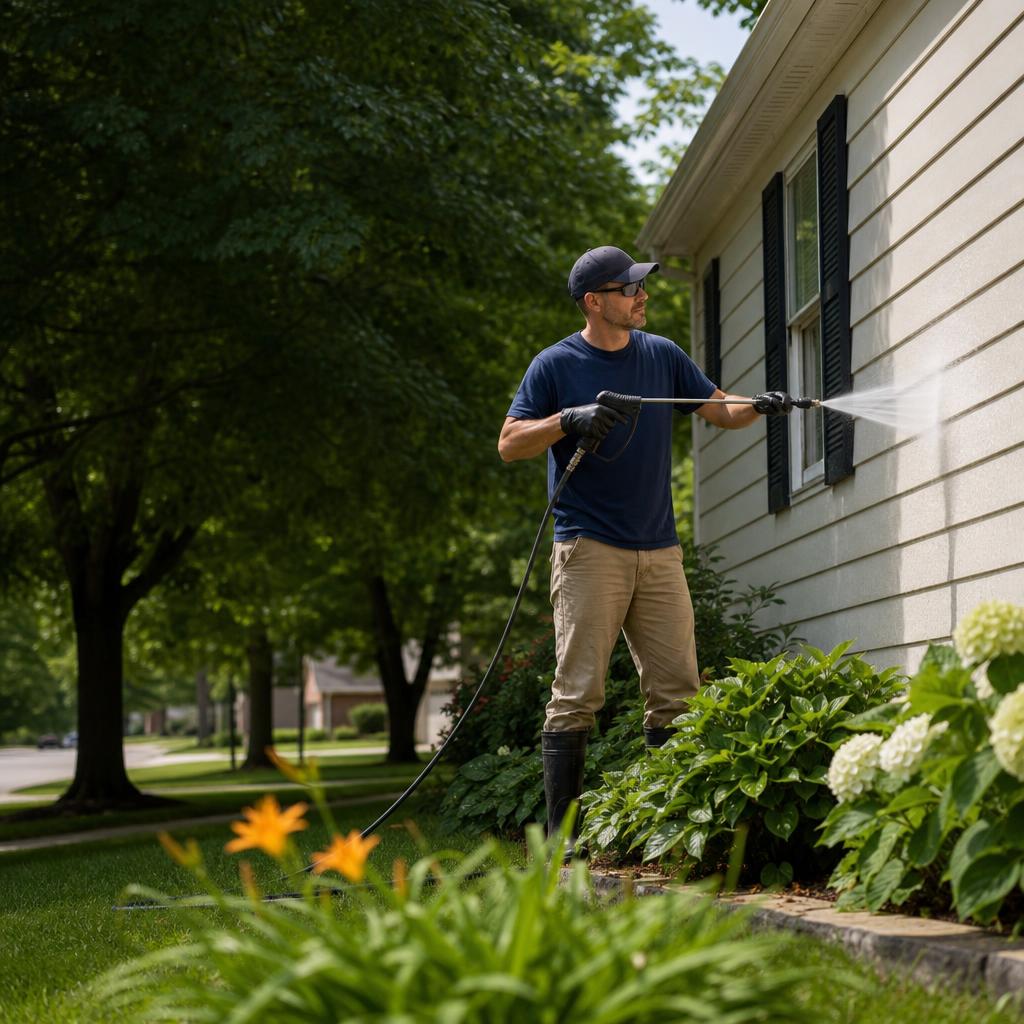
Walk down any suburban sidewalk in spring or summer, and you are almost guaranteed to spot it: a concrete driveway or back patio covered in permanent, dizzying squiggly lines, overlap grids, or bright white “zebra stripes.”
When homeowners rent or buy a high-powered pressure washer, they understandably assume that solid concrete is indestructible. After all, concrete supports 6,000-pound SUVs and endures decades of freezing winters and scorching summers. Surely a stream of water can’t hurt a slab of solid stone, right?
Unfortunately, thousands of homeowners discover the truth only after their driveway dries: Yes—improper pressure washing can permanently damage concrete in a matter of seconds.
If you have been wondering can pressure washing damage concrete, the reality lies in understanding how poured concrete is constructed, why concentrated water pressure acts like a liquid chisel against cement paste, and why the tools included in consumer pressure washer boxes are often the worst culprits behind scarred patios.
In this comprehensive technical guide, we will explain the anatomy of concrete etching, break down the 5 most common mistakes that ruin residential patios and driveways, show you whether etched concrete can be repaired, and reveal the exact rotary equipment and chemical techniques professionals use to clean concrete safely.
How Concrete Is Built: The Secret of the “Cream Layer”
To understand why high-pressure water can ruin a driveway or patio, you first need to know what happens on the day your concrete is poured.
Concrete is a composite material made of three primary ingredients:
- Coarse Aggregate: Gravel, crushed limestone, or river rock (which gives the slab its structural strength).
- Fine Aggregate: Sand (which fills the spaces between the gravel).
- Portland Cement Paste & Water: The chemical binder that hardens around the sand and gravel to lock everything together.
When concrete finishers pour a patio or driveway, they use long magnesium bull floats and steel trowels to work the wet slab. This troweling action pushes the heavy gravel aggregate down slightly and draws a smooth, dense 1/8-inch to 1/4-inch layer of fine sand and rich Portland cement paste up to the very top surface. In the concrete trade, this thin top skin is called “the cream” (or the surface cap).
Here is the critical vulnerability: That thin top “cream” layer is what gives your patio its uniform light-gray color, its slip-resistant broom texture, and its primary weather shield against freezing water. Once a high-pressure water jet blasts through that 1/8-inch cream layer, it exposes the rough, porous sand and gravel underneath—and the cream layer can never grow back.
4 Types of Concrete Damage Caused by Improper Pressure Washing
When someone asks “can pressure washing damage concrete?”, the damage generally falls into one of four distinct categories:
| Damage Type | Visual Appearance | Underlying Mechanical Cause | Is It Reversible? |
|---|---|---|---|
| 1. Surface Etching (“Wand Scars”) | Permanent squiggly lines, initials, or pale grooves cut into the slab. | Holding a narrow spray nozzle too close to the surface or using excessive PSI. | No (Requires resurfacing or grinding). |
| 2. “Tiger Striping” (Zebra Lines) | Alternating light and dark bands running across the patio or driveway. | Uneven overlap paths from a handheld wand or clogged rotary tips. | Yes (Can usually be blended via pro rotary re-washing & post-treatment). |
| 3. Aggregate Exposure & Pitting | Rough, sandy texture where small pebbles and pits show through the top. | Stripping away the top Portland cement “cream” layer with high pressure. | No (Accelerates winter freeze-thaw spalling). |
| 4. Expansion Joint & Sealant Blowout | Shredded rubber caulk or gouged wood strips between concrete slabs. | Passing a high-pressure jet directly over soft expansion joints. | Requires Re-Caulking (Leaves sub-base vulnerable to water erosion). |
1. Concrete Etching (The Liquid Chisel Effect)
When water is forced through a pinhole-sized orifice at 3,000 to 4,000 PSI, it exits the nozzle at supersonic speed. If that jet strikes the concrete just 2 to 4 inches from the surface, the kinetic energy pulverizes the calcium silicate hydrate bonds in the cement paste. It carves a permanent rough trench into the slab—much like sandblasting wood. Even after the rest of the patio gets dirty again next year, those etched grooves have a rougher texture that reflects light differently and traps dirt unevenly, making the wand scars stand out forever.
2. “Tiger Striping” (Zebra Lines)
Have you ever tried to color in a large poster board using a fine-point marker? No matter how steady your hand is, you end up with dark overlapping lines where the marker strokes cross.
Cleaning a 500-square-foot concrete patio with a 4-inch-wide handheld pressure washer fan tip produces the exact same result. Every time the operator swings their arm in an arc, the nozzle moves closer to the concrete in the center of the swing and further away at the edges. Once the concrete dries in the sun, the entire patio looks like a patchwork of light and dark zebra stripes.
3. Accelerated Winter Spalling and Flaking (The Freeze-Thaw Trap)
Here in St. Charles and St. Louis counties, our winters bring dozens of freeze-thaw cycles—where daytime snow melts at 42°F and refreezes into solid ice at 20°F overnight.
When improper pressure washing strips away the dense top “cream” cap of your concrete patio, the porous interior sand layer is left wide open to the sky. In winter, melting snow and de-icing salt soak deep into that exposed concrete. When the water freezes overnight, it expands by 9% in volume, popping off whole flakes and chunks of concrete in a destructive process called spalling.
The 5 Biggest Mistakes That Ruin Concrete Patios and Driveways
If you want to protect your hardscaping investment, you need to know the five specific errors that cause 99% of all pressure washing concrete damage:
-
Mistake #1: Washing “Green” Concrete Under 12 Months Old — Uncured cement paste strips and scars effortlessly under high pressure.
-
Mistake #2: Using the Red (0°) or Yellow (15°) Nozzle Tips — Pinpoint and chisel jets carve permanent grooves into concrete from a foot away.
-
Mistake #3: Cleaning Wide Slabs With a Handheld Wand — Swinging a narrow fan tip by hand guarantees uneven overlap bands and zebra stripes.
-
Mistake #4: Using 3,500+ PSI Without Chemical Pre-Treatment — Forcing out deep mold spores with raw water impact etches the surrounding slab.
-
Mistake #5: Blasting Stamped or Sealed Decorative Concrete — High PSI strips clear acrylic sealers and washes away antiquing color release.
Mistake #1: Pressure Washing New (“Green”) Concrete
How old is your concrete patio or driveway? Most homeowners assume concrete is fully hardened as soon as you can walk or park a car on it (7 to 28 days after pouring).
In reality, Portland cement cures through a slow chemical reaction called hydration that continues for 12 to 24 months. Concrete that is less than one year old is considered “green concrete” in the masonry industry. Its top cream layer is still relatively soft and fragile. Hitting a 6-month-old concrete patio with 3,000 PSI will instantly peel away the top finish and leave permanent fan marks.
The Rule: Never use high-pressure mechanical washing on concrete that is less than 12 months old (rely strictly on low-pressure chemical soft washing during the first year).
Mistake #2: Using the Red (0-Degree) or Yellow (15-Degree) Nozzle Tips
Almost every residential pressure washer comes with a color-coded set of five quick-connect nozzle tips clipped to the handle:
- Red Tip (0° Pencil Jet): Concentrates 100% of the pump’s force into a tiny pinpoint stream. Throw this tip away or hide it in a drawer. A 0-degree tip will carve your initials into a concrete driveway from a foot away.
- Yellow Tip (15° Chisel Tip): Designed for stripping paint off steel or heavy industrial prep. Used too close to residential concrete, a 15-degree tip easily etches lines into the cement paste.
- Green Tip (25°) & White Tip (40°): Wider fan angles that spread water impact over a broader area, reducing localized etching risk for edging work.
Mistake #3: Relying on Raw PSI Instead of Chemistry
When a homeowner encounters a dark black mold patch or a deep brown oak leaf stain on their patio, their natural instinct is to lower the pressure washer wand closer and closer to the concrete—inching the nozzle down to 1 inch above the slab until the black spot finally blasts off.
By the time raw water pressure blasts out a deep pore stain, you have already etched the concrete around it. Professional exterior cleaners never force out organic stains with raw PSI; instead, they apply a biodegradable sodium hypochlorite and surfactant pre-treatment that kills and loosens the black mold chemically so moderate, safe water pressure can rinse it away without harming the stone.
Mistake #4: Pausing or Changing Direction With a Wand Trigger Pulled
When cleaning with a handheld wand, stopping your arm movement for even half a second—or reversing direction in a tight zig-zag motion while the trigger is engaged—doubles the water impact at the pivot point. This leaves permanent horseshoe-shaped “stop marks” at the end of every stroke.
Mistake #5: High-Pressure Washing Stamped, Colored, or Sealed Concrete
Decorative stamped concrete patios depend on a clear topical acrylic sealer to protect the antiquing color release powder and give the stone its rich “wet look” sheen. Blasting stamped concrete with 3,000 PSI strips the clear sealer in ragged patches, turns the remaining sealer milky white (moisture blushing), and washes away the decorative accent color—costing thousands of dollars to strip and reseal.
Safe PSI Guidelines by Concrete Type
Different concrete finishes have very different pressure tolerances. Here is the exact reference chart professional technicians use before dialing in their pressure unloader valves:
| Concrete Surface Type | Maximum Safe PSI | Recommended Cleaning Method | Special Precautions |
|---|---|---|---|
| New Concrete (< 1 Year Old) | 100 – 500 PSI | Low-Pressure Soft Wash Only | Never use a high-pressure rotary cleaner on uncured concrete. |
| Exposed Aggregate Patios | 1,500 – 2,200 PSI | Soft Wash + Moderate Rinse | High PSI dislodges decorative river pebbles from the mortar bed. |
| Stamped / Colored Concrete | 800 – 1,500 PSI | Soft Wash + Gentle Fan Rinse | Protects the delicate topical acrylic sealer and color release layer. |
| Standard Broom-Finish Patio (1+ Yr) | 2,200 – 2,800 PSI | Pre-Treat + Rotary Surface Cleaner | Keeps broom texture intact while flushing deep capillary pores. |
| Cured Concrete Driveway (3+ Yrs) | 2,500 – 3,200 PSI | Pre-Treat + Rotary Surface Cleaner + Post-Treat | Ideal balance of deep pore lifting and zero surface etching. |
How Professionals Clean Concrete Without Etching or Zebra Stripes
If handheld pressure washer wands are so notorious for leaving zebra stripes and wand scars, how do professional concrete cleaning companies like Vossome Window Cleaning make a 1,000-square-foot driveway or patio look completely uniform from edge to edge?
We use a 3-Stage Commercial Rotary Surface Restoration System:
Soft-Wash Pre-Treatment
Biodegradable sodium hypochlorite & surfactants loosen deep pore grime and kill mold spores chemically before any pressure is applied.
Hovering Rotary Cleaner
A 20–24″ stainless-steel rotary bar spins at 1,800 RPM at a locked height and 25° angle—delivering high GPM flow with ZERO wand stripes.
Brightening Post-Treatment
Sanitizes microscopic capillaries, erases faint circular overlap shadows, and keeps concrete bright 2–3x longer.
1. The Commercial Rotary Flat-Surface Cleaner
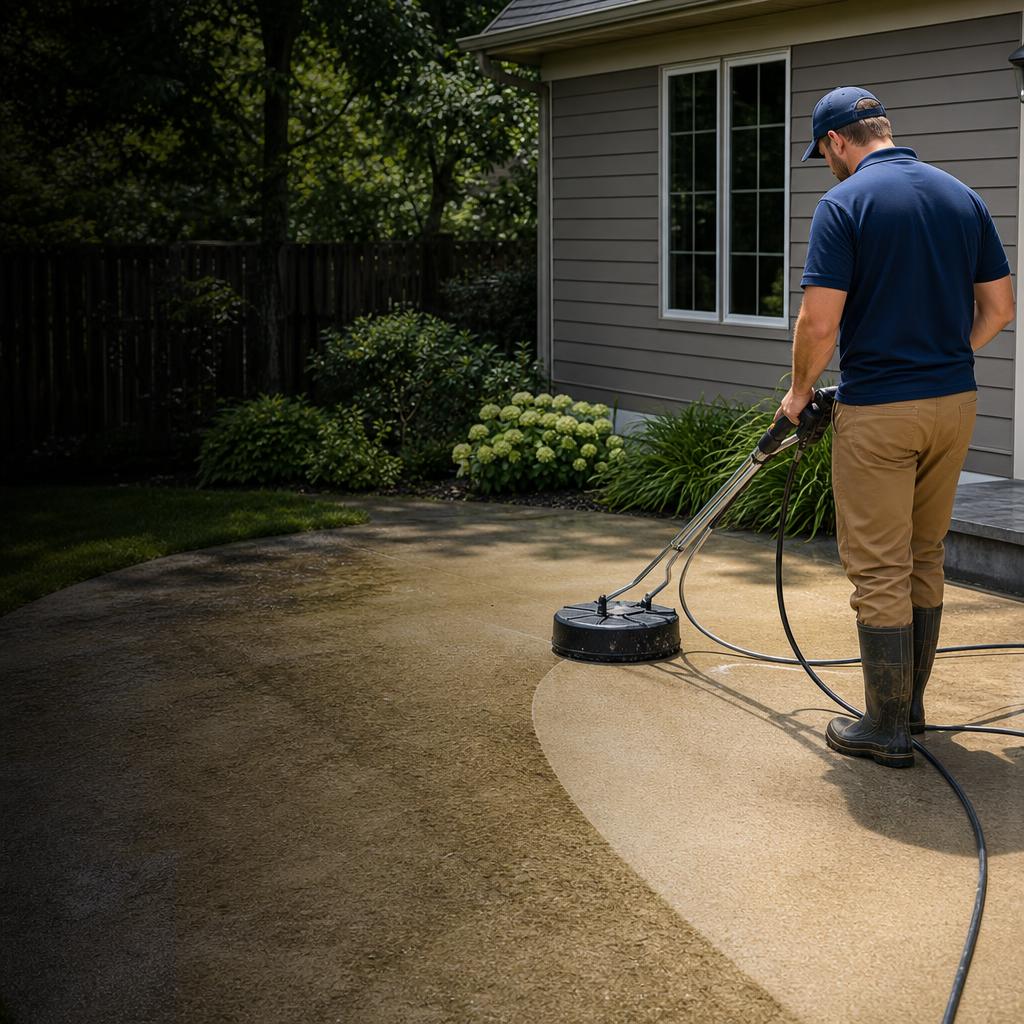
Instead of waving a handheld wand back and forth, our technicians operate a 20-to-24-inch commercial stainless-steel rotary surface cleaner (which looks similar to a heavy-duty floor buffer).
Underneath the protective steel skirt, a precision-balanced spray bar spins at 1,500 to 2,000 RPM, powered by high-volume water flow (5.5 to 8.0 Gallons Per Minute). Because the nozzles are locked into the spinning bar at a fixed height (roughly 1.5 inches above the slab) and a fixed 25-degree pitch angle, the water impact never fluctuates—eliminating the human error that causes wand etching.
2. Why High GPM Beats High PSI
Hardware store pressure washers try to compensate for weak water flow (2.0 GPM) by cranking up the pressure (3,200+ PSI), creating a needle-like spray that cuts into concrete.
Our commercial equipment flips that ratio: we dial the PSI down to a safe, surface-friendly level (2,500–3,000 PSI) while pumping 3 to 4 times the water volume (GPM). That massive volume of water lifts and flushes dirt out of the concrete pores gently and rapidly without chiseling the cream layer.
3. The Secret Weapon: Chemical Post-Treatment
Even with a commercial rotary surface cleaner, densely stained concrete can occasionally show faint circular overlap shadows immediately after rinsing. Once the slab is rinsed clean, our technicians apply a light, biodegradable soft-wash post-treatment across the entire patio or driveway. This final step kills any microscopic mold spores remaining inside the pores, melts away any faint overlap shadows, and brightens the concrete to a gorgeous, uniform finish.
Can You Fix Etched or Zebra-Striped Concrete?
What if you—or a previous homeowner—already pressure washed your concrete patio or driveway with a handheld wand and left behind ugly stripes or etched marks? Can it be fixed?
It depends entirely on whether the marks are Visual Tiger Stripes (Dirt Contrast) or Structural Etching (Carved Cement):
Scenario A: How to Fix “Tiger Stripes” (Dirt Contrast Lines)
Run your bare fingertips across the light and dark stripes on your dry concrete. If both the light lines and the dark lines feel equally smooth, you haven’t carved into the concrete! You simply have clean strips of concrete sitting next to still-dirty strips of concrete.
- The Fix: A professional exterior cleaning crew can easily fix this in about an hour by pre-treating the slab, going over the entire surface in a cross-hatch pattern (North-South, then East-West) with a commercial rotary surface cleaner, and applying a brightening post-treatment to blend the entire patio to match the cleanest lines.
Scenario B: How to Fix True Structural Etching (Gouged Concrete)
Run your fingertips across the marks again. If the bright white lines feel noticeably rougher, sandier, or physically recessed below the surrounding smooth concrete, the top cream layer has been permanently blasted away. Washing the surrounding concrete will not bring the missing cement paste back.
- Fix Option 1 (Mild Etching) — Professional Acid Etch Blending or Tinted Sealer: A masonry restoration specialist can lightly acid-wash or diamond-buff the surrounding intact concrete to reduce the texture contrast, followed by rolling on a breathable tinted concrete stain or opaque concrete sealer to hide the color discrepancy.
- Fix Option 2 (Severe Gouging) — Polymer-Modified Concrete Resurfacing: For deeply scarred patios, a concrete contractor can apply a 1/8-inch to 1/4-inch polymer-modified cement overlay (micro-topping) across the slab and broom-finish it, creating a brand-new wear layer without tearing out the patio.
Frequently Asked Questions (FAQ)
Is a “turbo nozzle” safe to use on a concrete patio?
Use extreme caution. A rotary turbo nozzle spins a 0-degree pinpoint stream in a rapid cone pattern. While turbo nozzles are effective for chewing up gum or blasting weeds out of brick cracks, holding a turbo nozzle less than 8 to 10 inches from residential concrete—or moving it too slowly—will permanently carve spiral circular rings (“crop circles”) into your patio. A wheeled rotary flat-surface cleaner is vastly safer and faster.
Why are small pebbles showing on my driveway after pressure washing?
If small stones and coarse sand are suddenly visible on the surface of your driveway after washing, either the pressure washer PSI was set too high and stripped away the weakened top cream layer, or prior winter de-icing salts (calcium/sodium chloride) had already chemically softened the surface paste, causing it to slough off under pressure.
Should you seal a concrete patio after pressure washing?
Yes—sealing is highly recommended in Missouri’s climate! Once a professional rotary pressure wash opens and sanitizes the microscopic pores of your concrete patio or driveway, applying a penetrating silane-siloxane water-repellent concrete sealer (once the slab dries for 24–48 hours) locks out future leaf stains, prevents winter water absorption and freeze-thaw spalling, and makes future cleanings effortless.
How often can you safely pressure wash a concrete driveway or patio?
When cleaned properly using chemical pre-treatment and a calibrated rotary surface cleaner (rather than aggressive high-PSI wand blasting), you can safely clean a cured concrete driveway or patio once every 12 to 18 months with zero wear to the concrete cream layer.
Trust Your Concrete Patio & Driveway to Vossome Window Cleaning
Don’t risk scarring your expensive concrete patio or driveway with a rented pressure washer and a handheld wand—and if you already have frustrating “zebra stripes” from an old DIY attempt, let our team blend and restore your slab to a spotless, uniform finish!
At Vossome Window Cleaning, our trained technicians use commercial high-flow rotary surface cleaners and biodegradable pre- and post-treatment solutions to clean concrete safely, thoroughly, and without a single wand mark.
We proudly serve homeowners throughout St. Charles County, St. Louis County, and surrounding Missouri communities, offering Concrete Patio & Driveway Cleaning, Low-Pressure House Soft Washing, Gutter Cleaning, and Pure-Water Window Cleaning.