Autumn in Missouri is arguably the most picturesque season of the year. Crisp morning air replaces summer humidity, backyard fire pits come to life, and the mature oak, maple, and hickory canopies across St. Charles and St. Louis counties burst into vibrant shades of crimson and gold.
However, as every experienced Midwest homeowner knows, that gorgeous autumn foliage carries a hidden countdown clock. Between late October and mid-December, calm autumn days quickly give way to freezing rain, sleet, heavy wet snow, and bone-chilling polar vortex drops.
Whatever dirt, wet leaves, clogged downspouts, or moisture-logged concrete pores are left untreated in November will get locked into solid ice by January. In the world of residential construction, water expands by roughly 9% when it freezes. When trapped water expands inside your gutters, beneath your roof shingles, or inside the microscopic capillaries of your concrete patio, it exerts thousands of pounds of destructive mechanical force.
Following a structured fall gutter and roof maintenance checklist—along with winterizing your siding, windows, and concrete hardscapes—is the single best way to prevent mid-winter ceiling leaks, torn-down gutters, cracked foundations, and flaking concrete slabs.
Here is your complete, step-by-step autumn exterior checklist to button up your property before the first hard freeze arrives.
Why Autumn Exterior Maintenance Is Non-Negotiable in the Midwest
Unlike spring exterior maintenance, which focuses heavily on curb appeal and washing away winter grime, fall maintenance is all about structural preservation and holiday readiness.
-
Uncleaned Fall Gutters → Freeze into 400-lb ice blocks, triggering winter ice dams and interior ceiling leaks.
-
Dirty Concrete Patios → Wet oak and walnut leaves dye stone brown; water-logged pores spall and flake during freezes.
-
Unwashed Siding → Low autumn sun and shaded fall moisture breed thick winter mold and green algae blooms.
-
Neglected Windows → Summer bug marks, sprinkler spots, and mower dust block winter daylight and dull holiday gatherings.
In the Greater St. Louis region, winter doesn’t simply freeze once in December and thaw once in March. Instead, our homes experience 40 to 60 individual freeze-thaw cycles every single winter—sunny 42°F afternoons where snow melts into liquid water, followed immediately by 18°F nights that freeze that water solid inside every crack and crevice.
Let’s walk through the four critical zones of your home’s exterior and how to protect each one before winter sets in.
Priority #1: The Fall Gutter and Roof Maintenance Checklist
Your roof valleys, gutters, and downspouts bear the heaviest brunt of autumn leaf drop and winter snow loads. Completing this 6-point roofline checklist in late fall protects both your attic ceiling and your basement foundation:
1. Clear Roof Valleys and Behind Chimneys/Skylights
Before even looking inside the gutter trough, look up at the “V” valleys where two roof slopes meet, as well as the upper saddle behind your chimney and skylights. Falling oak and maple leaves naturally collect in deep drifts inside roof valleys.
- Why it matters: Wet leaf piles sitting on asphalt shingles act like wet sponges, trapping moisture against the shingle seams and slowly rotting the underlying underlayment. Furthermore, the very first winter rainstorm will slide those valley leaf piles straight down into your newly cleaned gutters!
2. Scoop and Bag All Decomposing Leaves from Gutter Troughs
Once roughly 85% to 95% of the leaves have fallen from surrounding trees (typically mid-November through early December in Missouri), every linear foot of your gutter troughs must be cleared of wet leaves, acorns, pine needles, and decomposed shingle sludge.
How This Prevents Winter Ice Dams: If gutters are left full of wet leaves when December temperatures plunge below 32°F, the saturated debris freezes into an impenetrable log of solid ice filling the trough. When snow melts off your warm roof during the day, the water hits that frozen gutter wall and backs up underneath your lower rows of roof shingles—dripping straight through your roof decking and into your interior drywall ceilings.
3. Disassemble and Hydro-Flush Every Downspout Elbow
A spotless horizontal gutter trough is completely useless if a handful of twigs, sweetgum balls, or maple seeds is wedged inside the curved 90-degree downspout elbow. During your fall gutter cleaning service, every vertical downspout must be tested and flushed with high-volume water to verify 100% unobstructed flow from the roofline to the ground.
4. Inspect Gutter Pitch, Fascia Hangers, and Seam Miters
Wet snow and ice are extraordinarily heavy—a single cubic foot of solid ice weighs 57 pounds. Walk your roofline (or have your gutter technician check while on the ladder) for:
- Loose Spikes or Hidden Hangers: Any hanger screw pulling away from the fascia board should be tightened or reinforced before heavy winter snow loads pull the gutter down.
- Standing Water Bellies: If water pools 1 inch deep in the middle of a gutter run after flushing, that section will turn into a heavy ice rink all winter; the hanger pitch should be adjusted toward the downspout.
- Splash Blocks & Downspout Extensions: Make sure the bottom elbow of every downspout discharges water at least 4 to 6 feet away from your foundation wall so winter snowmelt doesn’t pool against your basement concrete and freeze-crack the foundation.
5. Flush and Brush Over Existing Gutter Guards
If your home has micro-mesh, screen, or helmet-style gutter guards installed, don’t skip your fall inspection! Wet autumn oak leaves and pine needles frequently mat flat across the top of gutter guards and freeze solid, causing melting snow to shoot right over the edge like a ski jump and form dangerous icicles over your front steps and driveway.
6. Check Roof Flashing and Plumbing Vent Boots
Cold winter temperatures cause rubber and metal roof components to contract. Have a technician visually check the black rubber neoprene boots around your rooftop plumbing vents for cracks, and verify that metal step flashing along dormers and chimneys is lying flat and sealed tight.
Priority #2: Concrete Patios, Walkways, and Driveways (Preventing Winter Spalling)
Most homeowners wait until spring to think about cleaning their concrete patio and driveway. However, autumn concrete cleaning is actually far more important for the structural survival of your concrete slab.
7. Remove Acidic Leaf Tannins Before They Dye the Slab
In October and November, falling oak, walnut, hickory, and maple leaves land on damp backyard concrete patios and front walkways. When wet leaves sit on concrete for even a week or two, they leach dark brown and orange tannic acid deep into the porous concrete cap. If left under the snow all winter, those organic tannins chemically dye the gray cement paste, leaving stubborn leaf silhouettes in the spring.
8. Rotary Pressure Wash Concrete to Prevent Freeze-Thaw “Spalling”
Have you ever seen a concrete driveway or patio where the smooth top layer has flaked, chipped, or popped off in ragged craters? That damage is called concrete spalling (or scaling), and it happens during winter freeze-thaw cycles.
- Dirt, moss, and algae sitting inside concrete pores act like a wet sponge.
- They hold melting snow and ice-melt water inside the top concrete cap.
- At night, that trapped water freezes and expands in volume by 9%.
- The mechanical expansion pops the top “cream” layer of concrete off in ragged flakes!
When you have your concrete patio, walkways, and driveway professionally cleaned in the fall using a commercial rotary surface cleaner, our technicians flush out all moisture-retaining dirt, moss roots, and algae from the concrete pores. Clean pores drain water rapidly instead of holding it like a sponge—dramatically reducing winter freeze-thaw flaking and eliminating slick green algae patches that become treacherous under winter frost!
9. Apply a Penetrating Sealer & Stock Concrete-Safe Ice Melt
Once your concrete is clean and dry on a mild autumn afternoon (above 50°F), applying a penetrating silane-siloxane water-repellent sealer locks moisture and road salt out of the pores all winter long.
Pro Winter Tip: While shopping for winter supplies, ditch bags of standard Rock Salt (Sodium Chloride) or fertilizers containing ammonium nitrate/sulfate, which chemically attack concrete. Instead, stock up on Calcium Magnesium Acetate (CMA) or Magnesium Chloride, which are far gentler on cured concrete and nearby landscaping.
Priority #3: Siding, Trim, and Exterior Envelope
As the sun drops lower in the southern sky during October and November, the north, east, and shaded west sides of your home receive very little direct sunlight. Dew and autumn rain linger on shaded siding for days at a time.
10. Soft Wash Summer Mold, Algae, and Insect Debris Off Siding
During late summer and early fall, spiders spin webs around every exterior coach light, soffit corner, and window frame, while green algae and black mildew feed on decaying autumn dust.
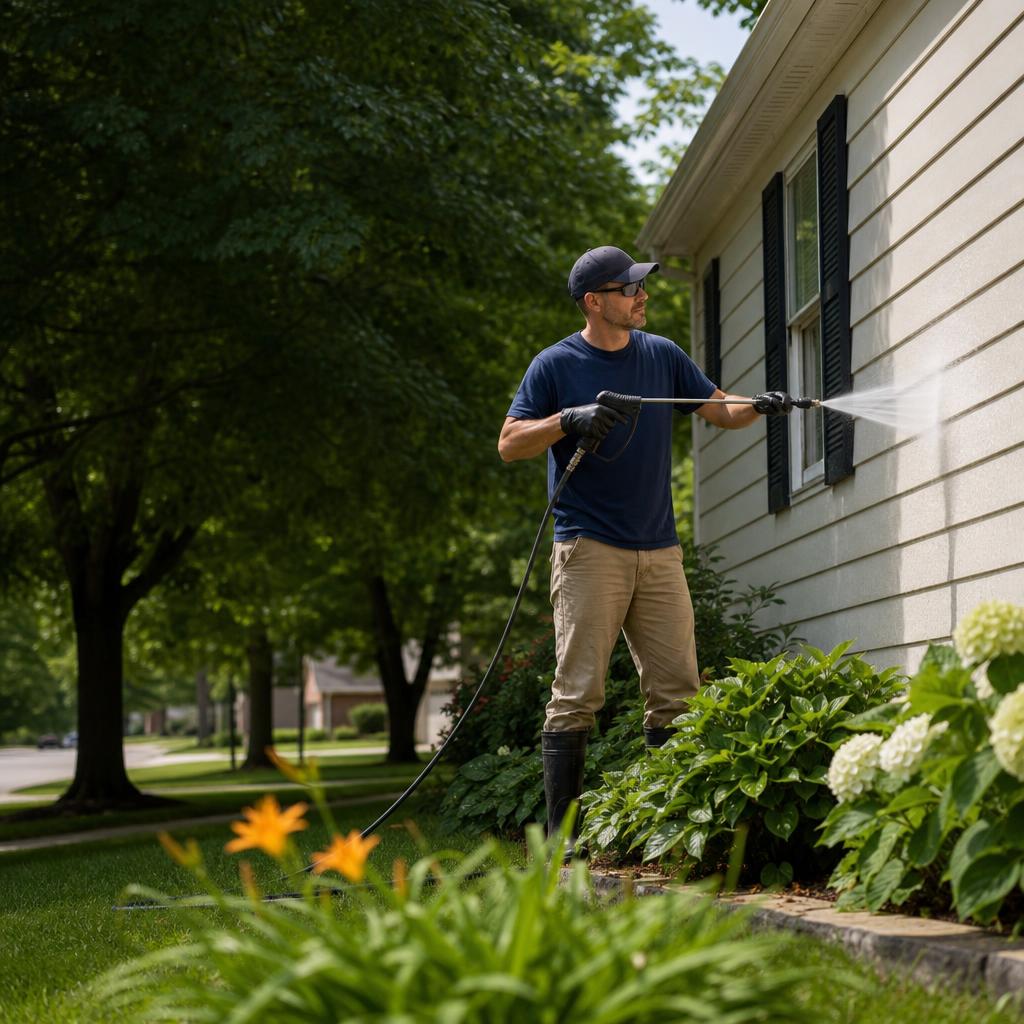
Scheduling a low-pressure house soft wash in the fall sanitizes your vinyl, brick, or stucco siding before winter sets in. By eliminating all living algae and mildew spores in the autumn, your home stays bright and clean straight through the winter and into late spring!
11. Seal Drafts, Cracks, and Rodent Entry Points
As nighttime temperatures drop into the 30s and 40s, field mice, squirrels, and overwintering insects (like boxelder bugs and stink bugs) actively search your home’s exterior walls for warm gaps to spend the winter:
- Check the rubber weatherstripping along the bottom of your garage doors; replace torn seals so mice and freezing winds can’t slip underneath.
- Seal gaps where air conditioning refrigerant lines, gas pipes, or fiber-optic cables penetrate your siding using copper mesh and exterior elastomeric sealant.
- Ensure attic gable vents and dryer exhaust flappers have intact 1/4-inch hardware cloth screens so squirrels and birds cannot nest inside.
Priority #4: Windows, Skylights, and Winterizing Utilities
Nothing makes the short, dark days of November, December, and January feel more cramped and gloomy than staring through dirty, bug-spotted windows—especially when family and friends gather at your home for Thanksgiving, Christmas, and New Year’s!
12. Schedule a Pre-Holiday Interior & Exterior Window Cleaning
Throughout the summer and early fall, exterior windows accumulate mower dust, lawn sprinkler splashes, tree sap mist, and spider droppings. Cleaning your windows in mid-to-late autumn offers three huge benefits:
- Maximizes Winter Daylight & Solar Warmth: With only 9.5 hours of daylight in December, spotless glass allows maximum natural sunlight into your living spaces, boosting mood and passive solar warmth.
- Holiday Entertaining Perfection: Whether you are hanging holiday wreaths and string lights around your front windows or hosting Thanksgiving dinner around the dining room bay window, crystal-clear glass elevates your entire home.
- Locking Windows Tight: When cleaning your interior windows and tracks, check that every sash locks tightly. Engaging the cam lock on double-hung windows pulls the upper and lower sashes together to seal out cold winter drafts.
13. Disconnect Garden Hoses and Winterize Exterior Spigots
Before the first hard freeze (28°F or lower) hits your neighborhood, complete this crucial 5-minute plumbing check:
- Unscrew every garden hose from your outdoor spigots! Even if your house has modern “frost-free” sillcocks, leaving a garden hose attached traps water inside the valve barrel right inside your exterior wall. When that trapped water freezes overnight, it splits the copper pipe inside your basement ceiling—causing a massive flood the next time you turn the spigot on in the spring.
- Shut off any interior isolation valves feeding outdoor kitchens or non-frost-free hose bibs, and blow out underground lawn irrigation lines.
Chronological Fall Exterior Maintenance Timeline (September – December)
To make planning effortless, follow this month-by-month Missouri schedule so you never get caught off guard by an early cold snap:
| Month | Optimal Outdoor Temp | Key Fall Maintenance Tasks |
|---|---|---|
| September – Early October | 60°F – 75°F |
• House Soft Wash (remove summer algae & spider webs) • Concrete Patio & Driveway Rotary Pressure Wash • Apply penetrating concrete sealer & caulk expansion joints • Inspect window caulking & garage door bottom seals |
| Mid-October – Early November | 50°F – 65°F |
• Pre-Holiday Interior & Exterior Window Cleaning (before Thanksgiving!) • Blow off wet oak/walnut leaves from concrete patio weekly • Book your late-November Gutter Cleaning slot early! |
| Mid-November – Early December | 38°F – 55°F |
• Full Roof Valley & Gutter Cleanout + Downspout Flush (once 90% of leaves are down) • Disconnect all garden hoses & winterize outdoor spigots • Verify downspout extensions point 4–6 ft away from foundation |
Why Smart Homeowners Bundle Fall Services Early
In the exterior cleaning industry, October and November are the busiest months of the entire year. Because every homeowner under mature oak and maple trees needs their gutters flushed after the leaves drop and their windows sparkling before Thanksgiving guests arrive, peak autumn calendar slots fill up fast!
By booking a Fall Exterior Bundle with a trusted local company like Vossome Window Cleaning in October or November, you get:
- Priority Scheduling: Lock in your ideal pre-holiday window and patio wash, plus your late-fall gutter cleanout window before winter weather arrives.
- Complete Safety Off the Ladder: Crisp autumn winds and damp leaves make DIY ladder climbing doubly treacherous. Our fully insured technicians use commercial ladder standoff stabilizers and safety gear to protect both themselves and your gutters.
- Multi-Service Package Discounts: Bundling your Fall Gutter Cleaning, Pure-Water Window Cleaning, Concrete Patio Washing, and House Soft Washing saves you time, money, and hassle!
Frequently Asked Questions (FAQ)
What if only half the leaves have fallen from my oak trees by November?
Pin oaks and white oaks in Missouri are famous for holding onto some of their brown leaves right into December. For heavily wooded lots with oak trees, we recommend scheduling your primary Gutter & Downspout Cleanout in late November or early December once the vast majority of the canopy has dropped. If your gutters are overflowing early in October from maple and birch leaves, a two-visit fall plan (October + early December) keeps your foundation dry all season.
Is it too cold in November or December to have my windows or gutters cleaned?
Not at all! Our technicians perform professional window cleaning and gutter flushing all the way through late autumn and winter as long as daytime temperatures reach 38°F to 40°F and above. For winter window cleaning, we even use specialized cold-weather solutions so water never freezes on your glass or sills.
Should I cover my concrete patio furniture or move it off the patio for winter?
If you leave metal-legged patio chairs sitting uncovered on a damp concrete patio all winter, snow and condensation trapped underneath the chair feet can leave orange rust rings or dark moisture halos on the concrete. After your fall patio wash, we recommend either storing furniture in a garage/shed or placing breathable covers over the set with plastic glides on the feet.
How can I tell if my downspouts are frozen or clogged in late fall?
During a late-autumn rainstorm (or when snow begins melting on a sunny afternoon), step outside and look at the bottom exit of each downspout. If water is dripping over the top lip of the gutter above, or if nothing is coming out of the bottom elbow while other spouts are gushing, you have a compacted leaf clog inside the elbow that must be cleared before it freezes solid and splits the aluminum seam!
Prepare Your Home for Winter with Vossome Window Cleaning
Don’t let clogged autumn gutters, stained patios, or dingy windows follow your home into the freezing winter months. Whether you need a thorough late-fall gutter cleanout and downspout flush to prevent winter ice dams, a pre-holiday window cleaning to make your home shine for Thanksgiving and Christmas, or a concrete patio and house soft wash before the snow flies, our team has you covered.
At Vossome Window Cleaning, we proudly serve homeowners throughout St. Charles County, St. Louis County, and surrounding Missouri communities, including O’Fallon, St. Peters, Wentzville, Chesterfield, and Lake St. Louis.