When green algae, black mildew streaks, and thick layers of dust start dulling your home’s exterior, your first instinct is probably to search for pressure washing. For decades, “pressure washing” has been the catch-all phrase homeowners use for any type of outdoor exterior cleaning.
However, applying high-pressure water to every surface on your property is one of the fastest ways to cause thousands of dollars in structural and cosmetic damage. If a contractor walks onto your driveway and offers to blast your vinyl siding, stucco, or roof shingles with 3,500 PSI of raw water force, you should stop them immediately.
Modern professional exterior cleaning relies on two distinct methodologies: high-pressure mechanical washing and low-pressure chemical soft washing. Knowing the difference between pressure washing vs. soft washing—and knowing exactly which surfaces on your property require which technique—is essential for protecting your home’s siding, windows, roof, and hardscaping.
In this comprehensive guide, we will break down the science, equipment, PSI ratings, and surface tolerances of both methods so you can make an informed, damage-free choice for your home.
Quick Comparison: Pressure Washing vs. Soft Washing at a Glance
Before diving into the technical mechanics of pumps, nozzles, and surfactants, here is how the two methods compare side-by-side:
| Feature | Traditional Pressure Washing | Professional Soft Washing |
|---|---|---|
| Operating Pressure (PSI) | 2,500 to 4,000+ PSI (High mechanical force) | 60 to 150 PSI (About the force of a garden hose) |
| Primary Cleaning Agent | High-velocity water impact (often paired with pre-treatment) | Biodegradable cleaning solutions, algaecides, & surfactants |
| How It Removes Organic Growth | Shears and blasts surface grime off via friction | Penetrates pores to kill algae, mold, and mildew at the root |
| Best Used On | Cured concrete driveways, sidewalks, patios, brick pavers | Vinyl siding, stucco, painted wood, James Hardie board, roofs |
| Risk if Misused | Etches soft wood/stone, strips paint, blows out window seals | Minimal structural risk; requires plant rinsing if over-applied |
| Longevity of Results | 6 to 12 months (spores often remain in pores) | 12 to 36 months (sanitizes the surface completely) |
What Is Pressure Washing? (High PSI Mechanical Force)
Pressure washing uses gas- or electric-powered pumps to force water through a narrow nozzle at high velocity, typically measuring between 2,500 and 4,000 Pounds per Square Inch (PSI) at a flow rate of 4 to 8 Gallons per Minute (GPM).
Note: You may also hear the term “power washing.” Technically, power washing is identical to pressure washing, except the machine uses a diesel-fired burner to heat the water up to 200°F—a method reserved for melting commercial chewing gum, axle grease, and heavy oil stains off concrete.
High-Pressure Pump: 3,000+ PSI
Commercial pumps pressurize water to 2,500–4,000 PSI at 4 to 8 GPM flow rates.
Narrow Nozzle / Rotary Cleaner
Spinning dual spray bars under a stainless-steel deck maintain an even height and angle.
Flushes Dense Concrete Pores
Mechanical shearing lifts deeply embedded tire marks, leaf tannins, and grime without wand stripes.
Why High Pressure Is Necessary for Hardscapes
Hard, porous masonry surfaces like concrete driveways, sidewalks, and aggregate patios act like rigid sponges. Over years of exposure to tire rubber, decaying oak leaves, motor oil, and Midwest freeze-thaw cycles, dirt gets packed deep inside the microscopic capillaries of the concrete.
Garden hose pressure simply glides over the top of concrete. To flush embedded dirt out of those rigid concrete pores, you need the mechanical shearing force of high-pressure water—ideally delivered through a commercial rotary flat-surface cleaner that hovers evenly over the slab to prevent wand streaks (“tiger striping”).
What Is Soft Washing? (Low PSI + Specialized Chemistry)
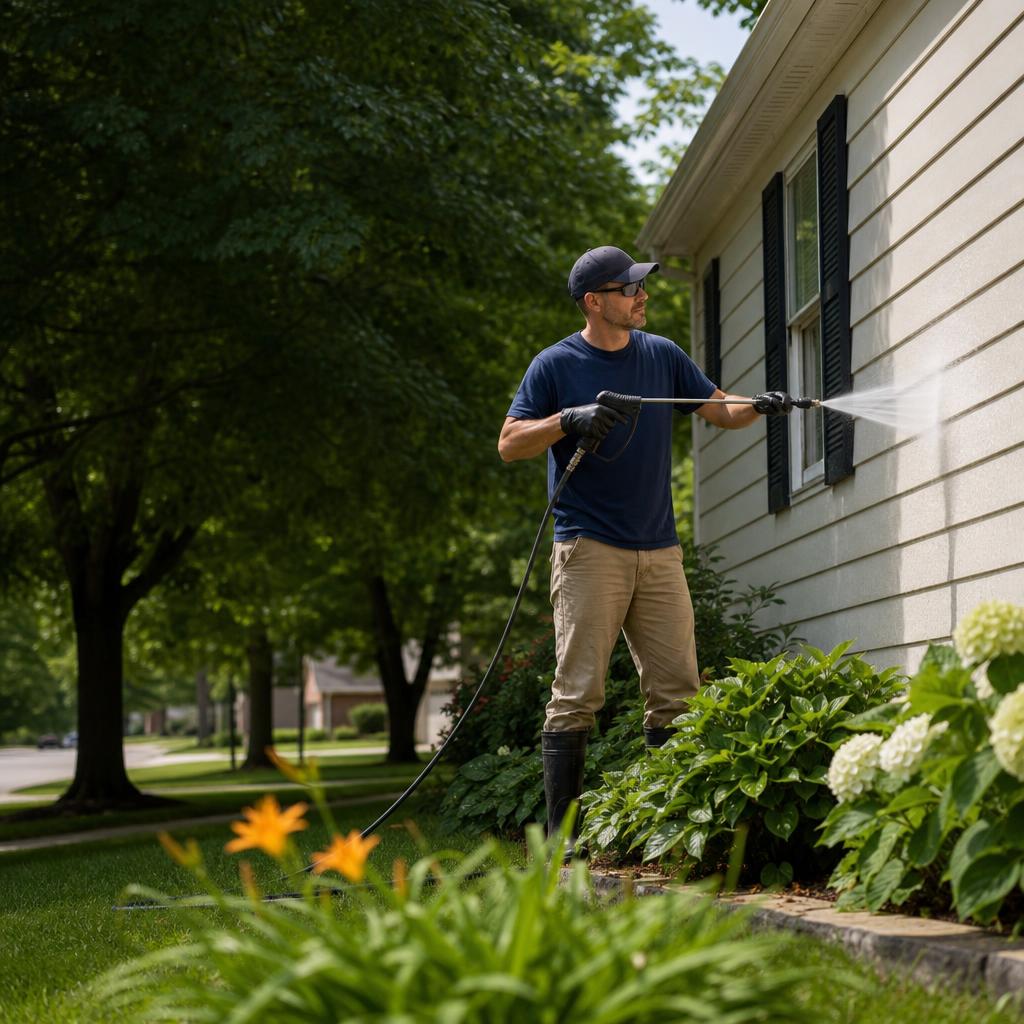
Soft washing turns the traditional pressure washing equation upside down. Instead of using brute physical force to blast dirt away, soft washing relies on specialized, biodegradable water-based chemistry to do the heavy lifting, followed by a gentle, high-volume, low-pressure rinse at 60 to 150 PSI—roughly the same pressure as putting your thumb over the end of a backyard garden hose.
The Science Behind Why Siding Turns Green and Black
When you see green patches on the north-facing side of your house or black streaks running down your siding and gutters, you aren’t looking at ordinary mud or dirt. You are looking at living, colonizing microorganisms:
- Green Algae (Chlorophyta) that thrives in damp, shaded areas.
- Black Cyanobacteria (Gloeocapsa magma), a hardy bacteria that feeds on limestone fillers and moisture.
- Fungal Mildew and Lichens that anchor microscopic root structures (hyphae) into the texture of your siding and paint.
Why Blasting Algae with High Pressure Fails
If you hit green algae or mildew on vinyl siding with high-pressure water alone, you only shear off the top visible layer of the organism—much like mowing over weeds in your yard. The microscopic roots remain embedded in the textured grain of your siding, and the high-pressure mist scatters millions of live spores across the rest of the wall. Within a few humid summer months, the green bloom returns thicker than before.
Soft washing solves this permanently. By applying a custom-blended solution of sodium hypochlorite (at safe, diluted residential strengths), specialized foaming surfactants, and rinsing agents, soft washing breaks down spider webs, emulsifies grime, and neutralizes 100% of the algae and mold spores at the cellular level. Once the organisms die and release their grip on the siding, a gentle, low-pressure rinse washes them away effortlessly—keeping your home cleaner two to four times longer than pressure washing alone.
5 Ways High-Pressure Washing Destroys House Siding & Windows
Homeowners who rent a consumer pressure washer from a hardware store or hire an inexperienced, “splash-and-dash” contractor often discover costly damage once the house dries. Here is why high PSI should never touch the vertical walls of your home:
-
Water Intrusion Behind Siding: Traps moisture inside wall cavities and breeds toxic mold.
-
Oxidation “Wand Scars”: Etches permanent squiggly zebra marks into aged vinyl and aluminum.
-
Blown Window Thermal Seals: Causes permanent internal fogging between double-pane glass.
-
Stripped Paint & Splintered Wood: Ruins cedar shake, painted trim, and James Hardie board.
-
Cracked Stucco & Loose Mortar: Chisels away textured stucco finishes and historic brick joints.
1. Water Forced Behind Vinyl and Hardie Siding
Vinyl and fiber-cement lap siding are engineered to shed rainwater flowing downward by gravity. They include tiny drainage perforations along the bottom lip called weep holes, and the panels overlap loosely to allow expansion and contraction in summer heat and winter cold.
When a high-pressure wand blasts water upward or horizontally against siding at 3,000 PSI, gallons of water shoot underneath the overlaps and straight through the weep holes. That water soaks your interior OSB sheathing, saturates fiberglass wall insulation, shorts out exterior GFCI electrical outlets, and breeds dangerous black mold inside your wall cavities.
2. Permanent Oxidation Scars on Vinyl and Aluminum
As vinyl and aluminum siding age in the sun, UV rays break down the top layer of pigment, creating a fine, chalky powder on the surface known as oxidation (if you rub your hand across older siding and come away with chalky residue, your siding is oxidized).
If you hit oxidized siding with a narrow high-pressure nozzle, the jet will blast away lines of oxidation where the wand passes closest, leaving permanent, irreversible “wand scars” or squiggly zebra stripes across the entire side of your house. Soft washing cleans over oxidized siding gently without disturbing the chalky layer, preserving a uniform color.
3. Ruptured Double-Pane Window Seals and Shredded Screens
Professional window cleaners know that modern double-pane windows rely on a delicate perimeter butyl seal to keep argon gas inside and humid air outside. High-pressure water striking window frames easily ruptures this seal. Days or weeks later, moisture condenses between the glass panes, creating permanent internal fogging that requires expensive glass replacement. High PSI also tears fiberglass window screens and dents hollow aluminum screen frames.
4. Splintered Wood and Chipped Paint
On painted wood trim, cedar shake siding, or composite fascia boards, high pressure acts like a liquid chisel. It strips away protective exterior latex paint, gouges soft wood grain into fuzzy splinters (“furring”), and forces moisture deep into the bare wood fibers, causing rapid rot and peeling once the sun comes out.
5. Damaged Stucco, EIFS, and Brick Mortar
Synthetic stucco (EIFS) and traditional cement stucco have delicate, textured acrylic or masonry finishes that crack and flake off under high pressure. Even on traditional red brick homes, blasting older mortar joints with a narrow pressure tip erodes the sand-and-lime mortar, weakening the structural integrity of the brickwork.
Surface-by-Surface Guide: Which Method Should You Use?
To take the guesswork out of your exterior maintenance plan, use this comprehensive material checklist to see which cleaning method belongs on each area of your property:
| Exterior Surface Material | Recommended Method | Ideal PSI Range | Why This Method Is Required |
|---|---|---|---|
| Vinyl Siding | Soft Wash | 60 – 100 PSI | Prevents water intrusion behind panels and oxidation striping. |
| Stucco & Dryvit (EIFS) | Soft Wash | 60 – 80 PSI | Dissolves deep pore algae without cracking or pitting the textured finish. |
| Painted Wood & Cedar | Soft Wash | 60 – 100 PSI | Preserves paint adhesion and prevents wood grain splintering. |
| James Hardie (Fiber Cement) | Soft Wash | 80 – 150 PSI | Manufacturer warranties explicitly prohibit high-pressure washing. |
| Aluminum Gutters & Soffits | Soft Wash + Brush | 60 – 100 PSI | Removes black electrostatic “tiger stripes” without denting thin metal. |
| Asphalt Roof Shingles | Soft Wash ONLY | 40 – 60 PSI | High pressure strips protective ceramic granules and voids roof warranties. |
| Composite Decks (Trex/Azek) | Soft Wash | 100 – 300 PSI | Kills embedded mold pores without scarring the polymer capstock. |
| Brick Siding (Vertical Walls) | Soft Wash / Low PSI | 150 – 500 PSI | Kills moss and mildew without eroding mortar joints or saturating weep holes. |
| Concrete Driveways & Sidewalks | Pressure Wash | 2,500 – 3,500 PSI | Requires a rotary surface cleaner + chemical post-treatment for deep pore cleaning. |
| Concrete Patios & Pool Decks | Pressure Wash | 2,000 – 3,000 PSI | Lifts stubborn leaf tannins, patio grease, and compacted dirt safely. |
The Secret of Hybrid Cleaning: How Pros Clean Concrete Patios & Driveways
Interestingly, the best exterior cleaning contractors don’t treat pressure washing and soft washing as mutually exclusive when it comes to concrete patios and driveways. Instead, they combine both sciences into a Hybrid Restoration Process:
- Step 1: Pre-Treatment (Soft Wash Chemistry): Before any high-pressure equipment touches your concrete patio or driveway, technicians apply a specialized biodegradable pre-treatment surfactant. This loosens organic dirt, softens black lichen spots, and begins breaking down leaf stains.
- Step 2: Mechanical Rotary Cleaning (Controlled Pressure Washing): Instead of using an uneven handheld wand, technicians run a commercial rotary surface cleaner over the concrete. Underneath a protective stainless-steel deck, dual spinning spray bars clean the concrete at a locked, consistent height and angle—flushing deep dirt out of the pores without leaving wand lines.
- Step 3: Low-Pressure Rinse & Post-Treatment: After rinsing away the muddy slurry, technicians apply a light soft-wash post-treatment across the clean concrete. This eliminates any lingering invisible spore roots inside the concrete pores and brightens the slab to a uniform, glowing finish.
Are Soft Washing Solutions Safe for Landscaping, Pets, and Windows?
A common question conscientious homeowners ask is: “If soft washing uses cleaning solutions to kill algae and mold, will it harm my flowerbeds, lawn, pets, or windows?”
When performed by trained professionals using strict property-protection protocols, soft washing is completely safe for your yard and home:
- 100% Biodegradable Solutions: The active ingredients used in professional soft washing break down rapidly into harmless water and trace salt once exposed to sunlight and organic soil.
- The “Pre-Wet, Rinse, and Neutralize” Protocol: Before applying a single drop of cleaning solution to your siding, reputable technicians thoroughly saturate all surrounding grass, boxwoods, hostas, and flowerbeds with fresh water. Once plant leaves and root systems are full of fresh water, they cannot absorb any stray mist. After washing the siding, technicians rinse all foliage again and apply neutralizing plant washes when necessary.
- Spot-Free Window Protection: If soft wash detergents dry on hot window glass, they can leave behind filmy soap marks. That is why hiring a company that specializes in both professional window cleaning and exterior washing (like Vossome Window Cleaning) gives you a massive advantage: our technicians ensure your glass is thoroughly rinsed and spotless when the house wash is complete.
Questions to Ask Before Hiring an Exterior Washing Company
Before signing an estimate to have your house or patio washed, ask the contractor these three diagnostic questions to verify they won’t damage your property:
-
“What PSI and method do you use to clean vinyl, stucco, or painted siding?”
The Right Answer: They should immediately explain their low-pressure soft washing process (under 150 PSI) using biodegradable algaecides and surfactants. If they say they climb ladders with high-pressure wands to blast the siding, do not hire them. -
“How do you clean concrete driveways and patios without leaving zebra stripes?”
The Right Answer: They should state that they use a commercial rotary flat-surface cleaner combined with pre- and post-treatment solutions, rather than cleaning wide areas with a handheld wand tip. -
“How do you protect my landscaping, exterior electrical outlets, and windows?”
The Right Answer: They should detail taping off exterior keyholes, cameras, and non-watertight outlets, pre-watering all plants, and thoroughly rinsing all windows upon completion.
Frequently Asked Questions (FAQ)
Does soft washing remove those stubborn black “tiger stripes” on the outside of my gutters?
Standard soft washing will remove green algae and loose dirt from gutters, but the vertical black streaks on the face of white aluminum gutters (known as electrostatic tiger striping) are actually caused by oxidized asphalt oils and road grime bonding to the baked enamel finish. Removing tiger stripes requires a specialized gutter-brightening degreaser applied with a soft-bristle extension brush, which we offer as part of a comprehensive exterior detail.
How often should I have my house soft washed?
In the humid Midwest climate of Missouri, most homes benefit from a professional soft wash every 18 to 24 months. Homes nestled in heavily wooded lots, near lakes or creeks, or with shaded north-facing walls may prefer an annual wash each spring to keep green algae from establishing a foothold.
Will soft washing peel or fade my exterior house paint?
No. Unlike high-pressure washing, which physically blasts paint chips off wood and siding, soft washing uses gentle garden-hose pressure that will never strip sound paint. In fact, removing acidic mold, mildew, and dirt buildup actually extends the lifespan of your exterior paint job and brightens its original color.
Should I get my house washed or my windows cleaned first?
Always schedule your house soft washing and concrete pressure washing first—or better yet, book them together on the same day with the same company! Washing your siding and patios stirs up airborne mist, loosened pollen, and organic runoff that inevitably lands on your exterior glass. Cleaning your windows immediately after the house wash leaves your entire property sparkling from top to bottom.
Protect and Beautify Your Home with Vossome Window Cleaning
Your home is your largest investment—it deserves an exterior cleaning team that understands the science of surface safety. Whether your vinyl siding needs a gentle, restorative soft wash to erase years of green algae, or your concrete driveway and patio need deep pressure washing with commercial rotary surface cleaners, you never have to worry about damaged siding or blown window seals.
At Vossome Window Cleaning, we proudly serve homeowners throughout St. Charles County, St. Louis County, and surrounding communities. Because we are masters of both exterior pressure/soft washing and pure-water window cleaning, we can bundle your house wash, patio cleaning, gutter cleaning, and window washing into one seamless, stress-free appointment!